farishattab5@gmail.com LinkedIn

AI System · 2026 to Present

AI Audit System

A custom Claude-based design audit and competitive benchmarking system, built to run UX evaluations the way an experienced designer would.

Codifying design judgment into reusable AI infrastructure.

Role
Designer and builder
Timeline
2026 to Present
Built with
Claude, Zyte API, Python
Output
Branded, evidence-backed reports
Scope
25 reports, 10 platforms
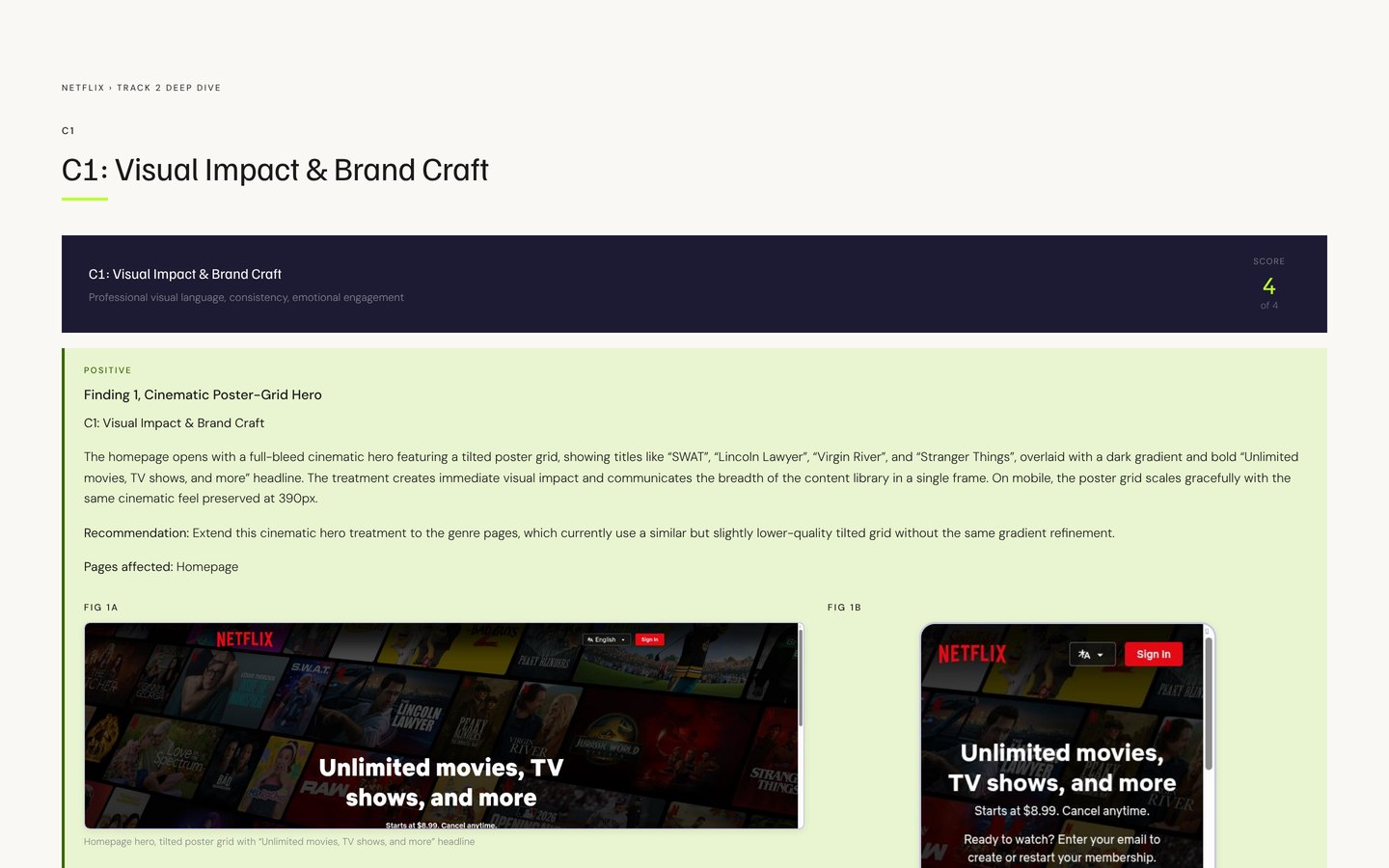
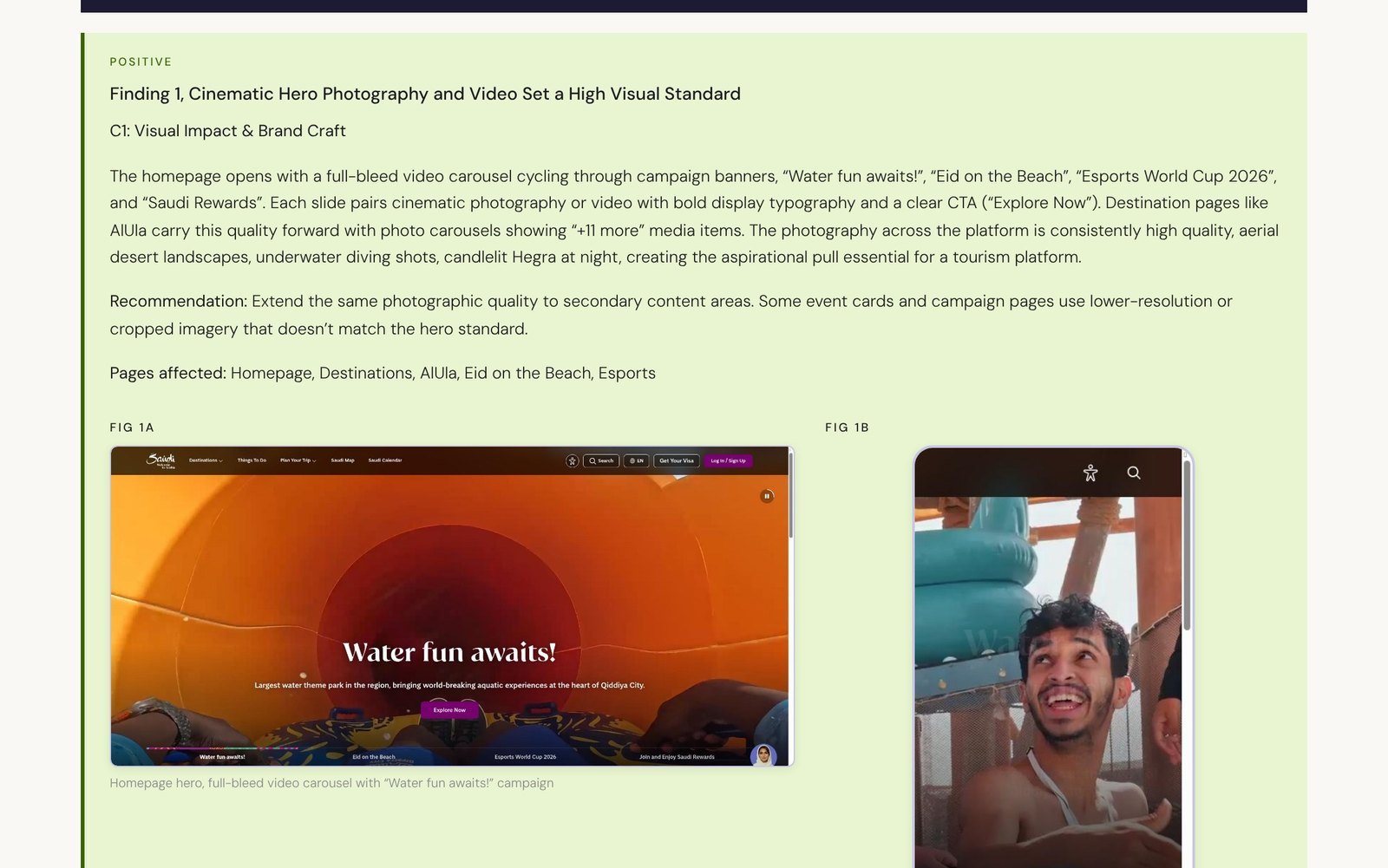
A positive finding from the Visit Saudi deep dive, with desktop and mobile evidence
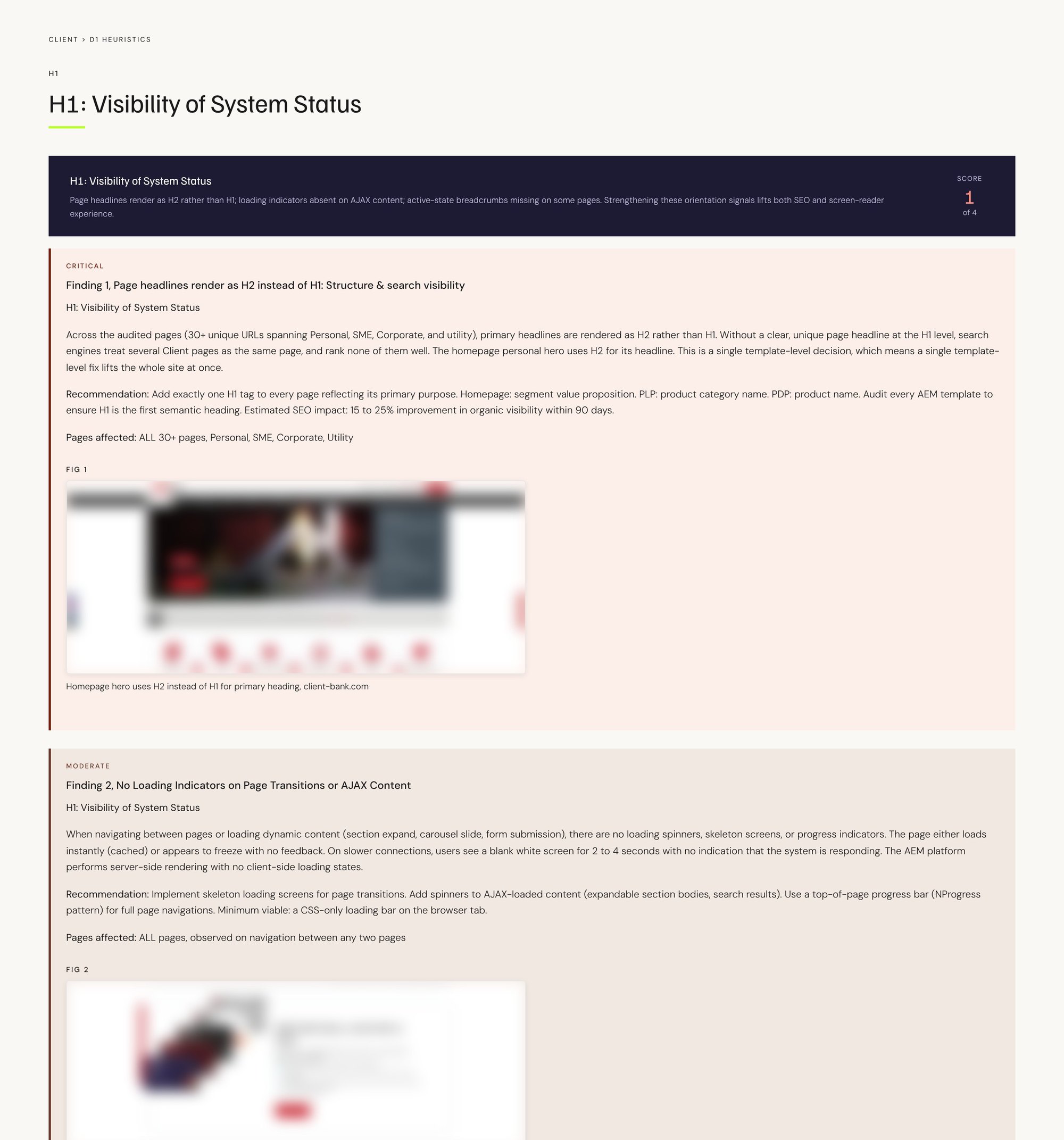
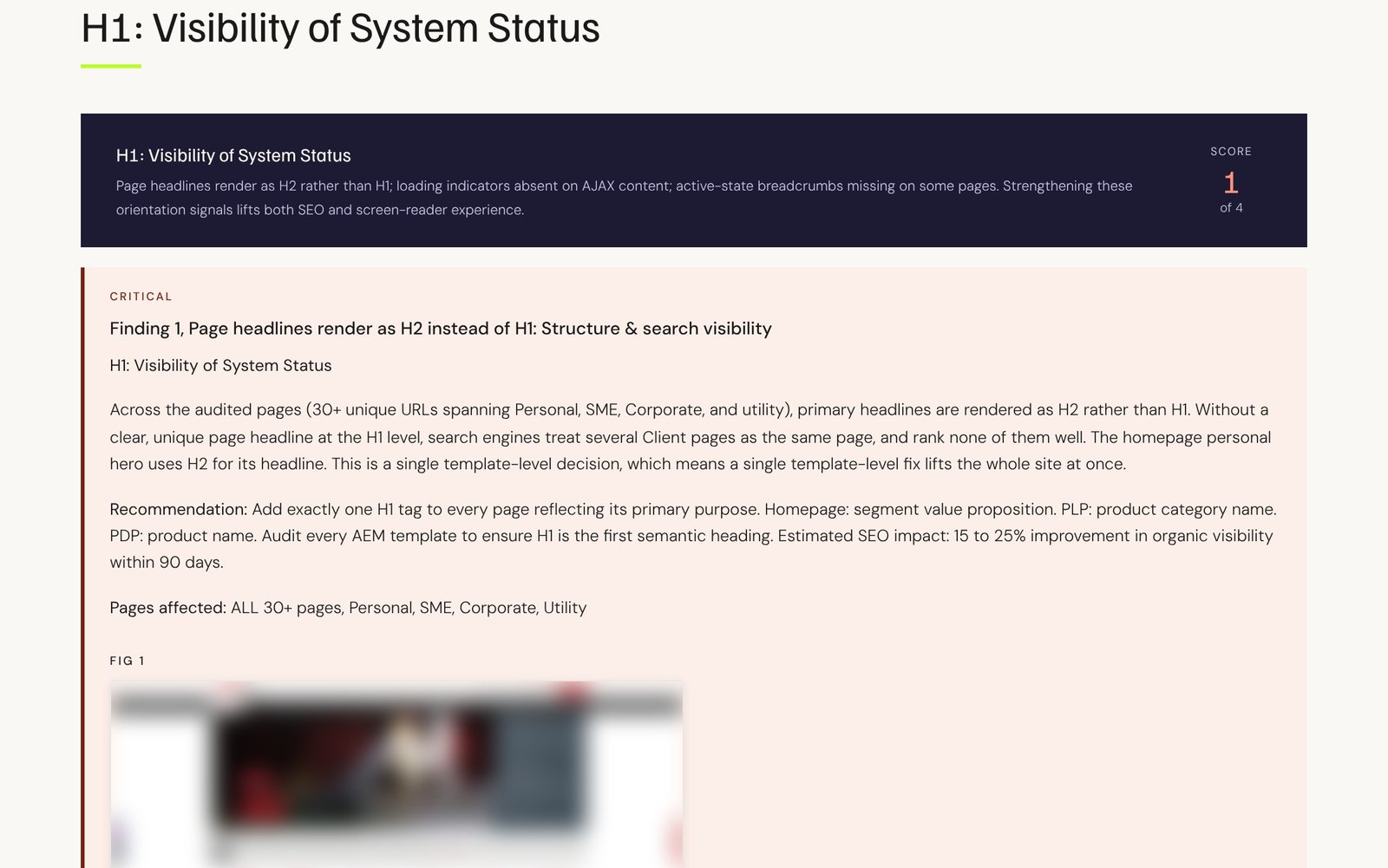
A critical finding from the client heuristics audit, with its score

At a glance

The challenge

A competitor audit took a week of manual work, and the depth had to hold across every platform, every audit and every team.

The approach

Codify heuristics, design execution standards and a four-dimension scoring framework into reusable AI skills.

Impact

  1. A week of competitor audit work now ships in hours, with the same depth
  2. 25 scored reports across 10 platforms for one client engagement
  3. Every finding verified against live page data, with 295 screenshots behind the client’s heuristics audit alone
  4. Findings ranked critical, moderate and minor, so teams know what to fix first

01 The Problem

Most AI design tools speed up production. This one slows it down on purpose.

It encodes the way a senior designer evaluates work, so the depth holds across audits, across teams, across time.

The brief: benchmark a bank's website against its direct competitors and against best-in-class platforms from outside banking, across every segment and both languages, with findings the client could act on. Done by hand, a single competitor audit took a week.

02 The System

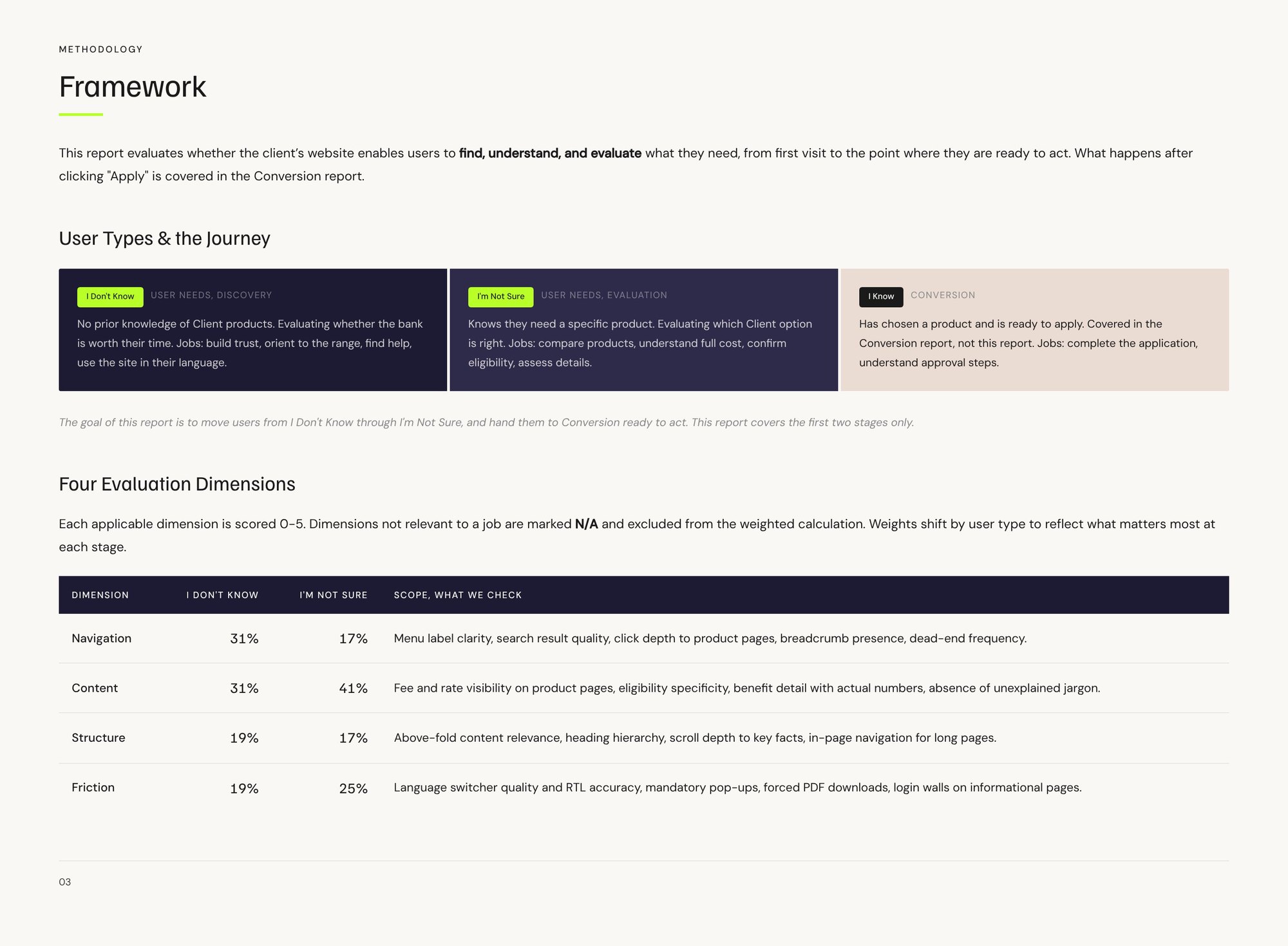
The audit framework: user types and evaluation dimensions

Step 01

Foundation

Every audit starts from the same brief: the business objectives, the segments, and the user need states a visitor moves through, from I Don't Know to I'm Not Sure to I Know.

For the client, that meant Personal, SME and Corporate banking, in English and Arabic.
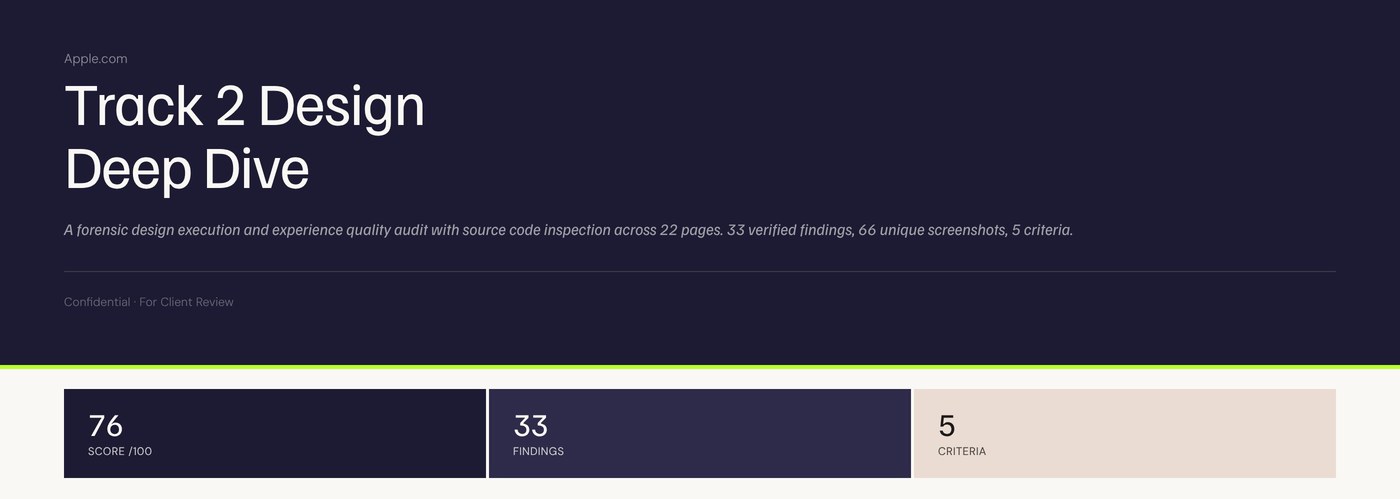
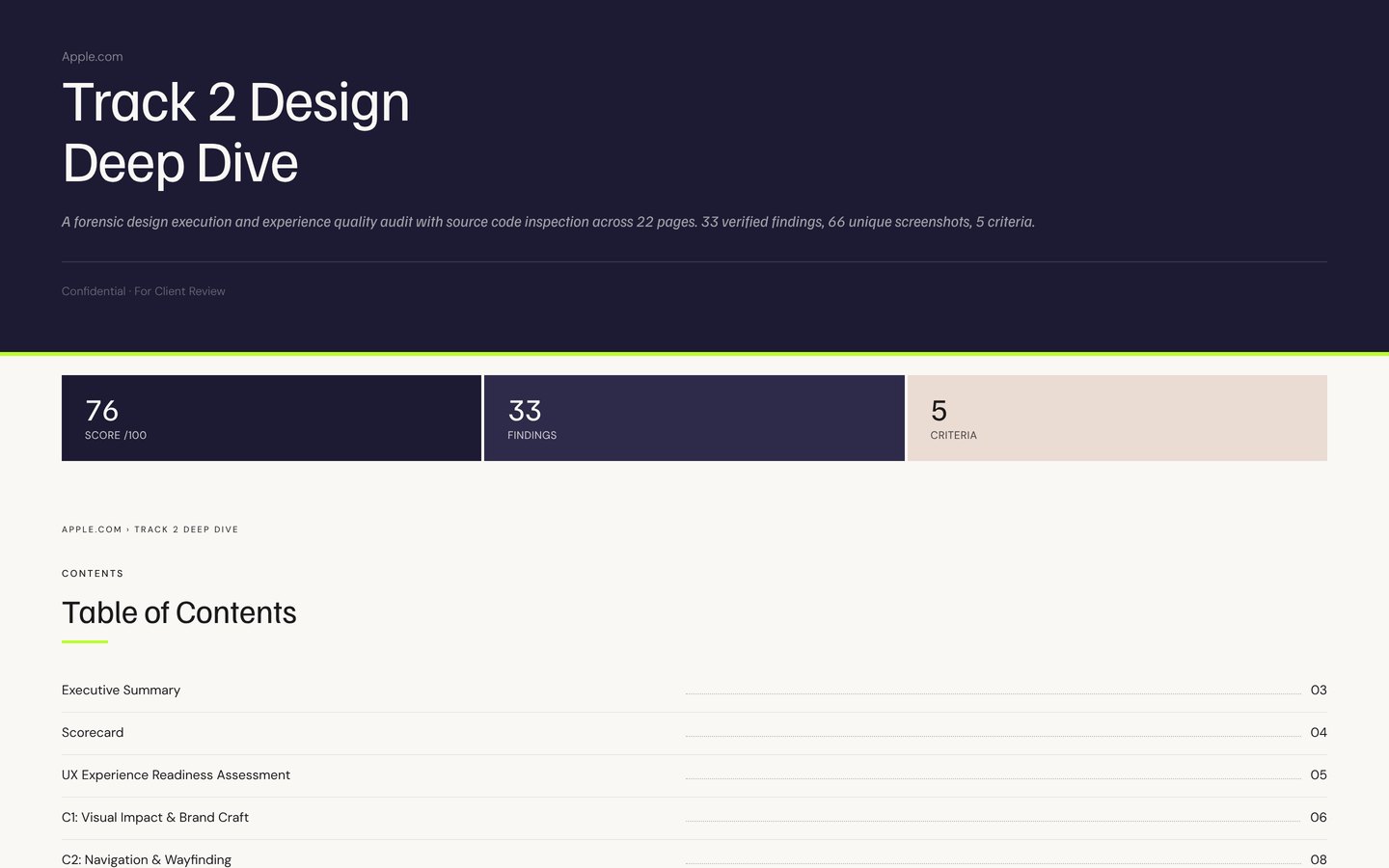
A Track 2 deep dive cover

Step 02

Classify the field

Before anything is scored, each platform is classified. Direct competitors get a full 100-point Track 1 audit. Best-in-class references from outside the category get a Track 2 design deep dive across five criteria.

Four competitors and five references made the field for this engagement.

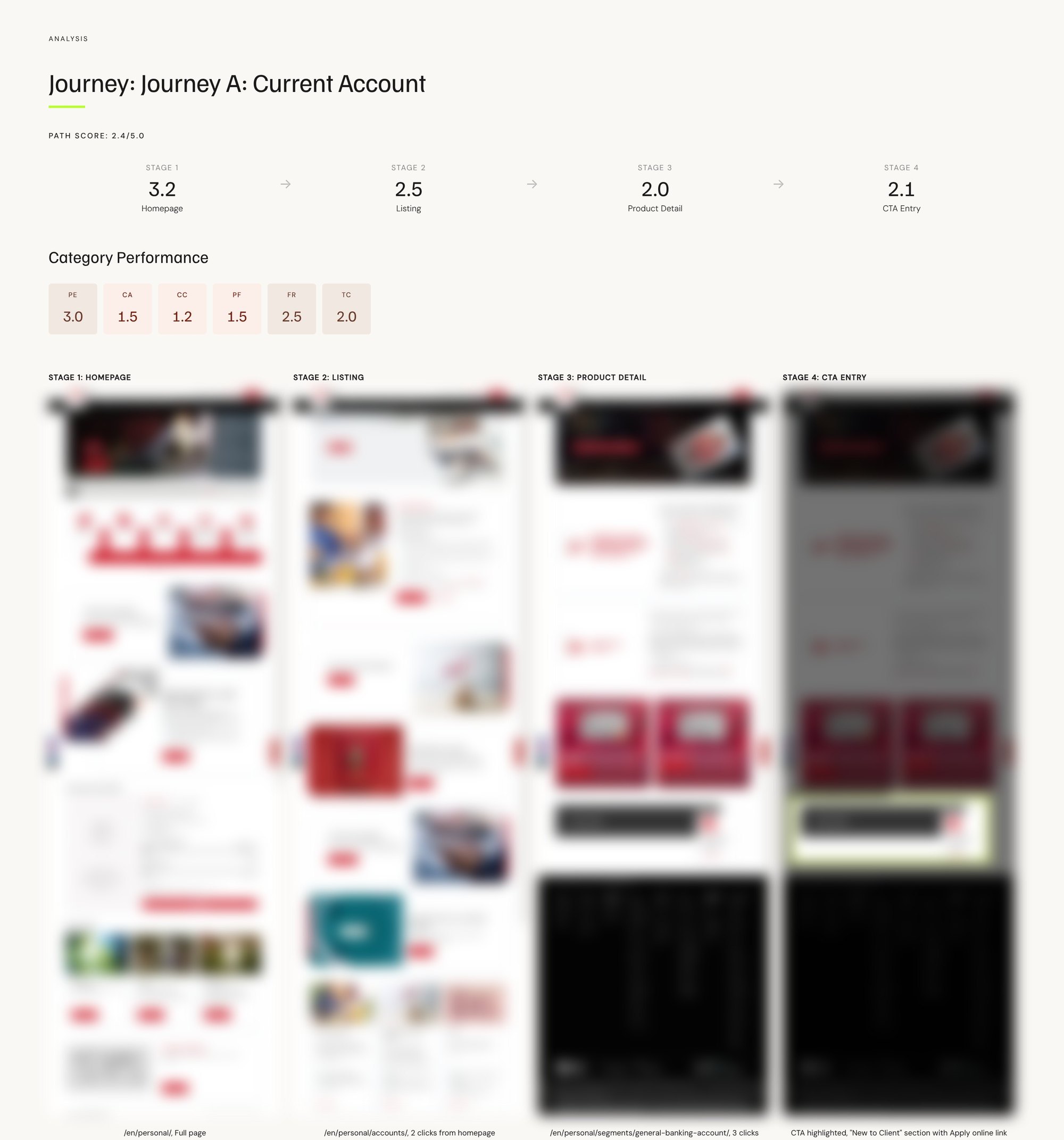
A conversion journey captured stage by stage, with site screenshots blurred

Step 03

Capture the evidence

Live pages are pulled through the Zyte API: full HTML plus full-page screenshots across segments, languages and page sections.

The HTML is parsed for structure, from heading hierarchy and ARIA landmarks to focus styles and schema markup, and computed styles are audited for spacing, colour and type.

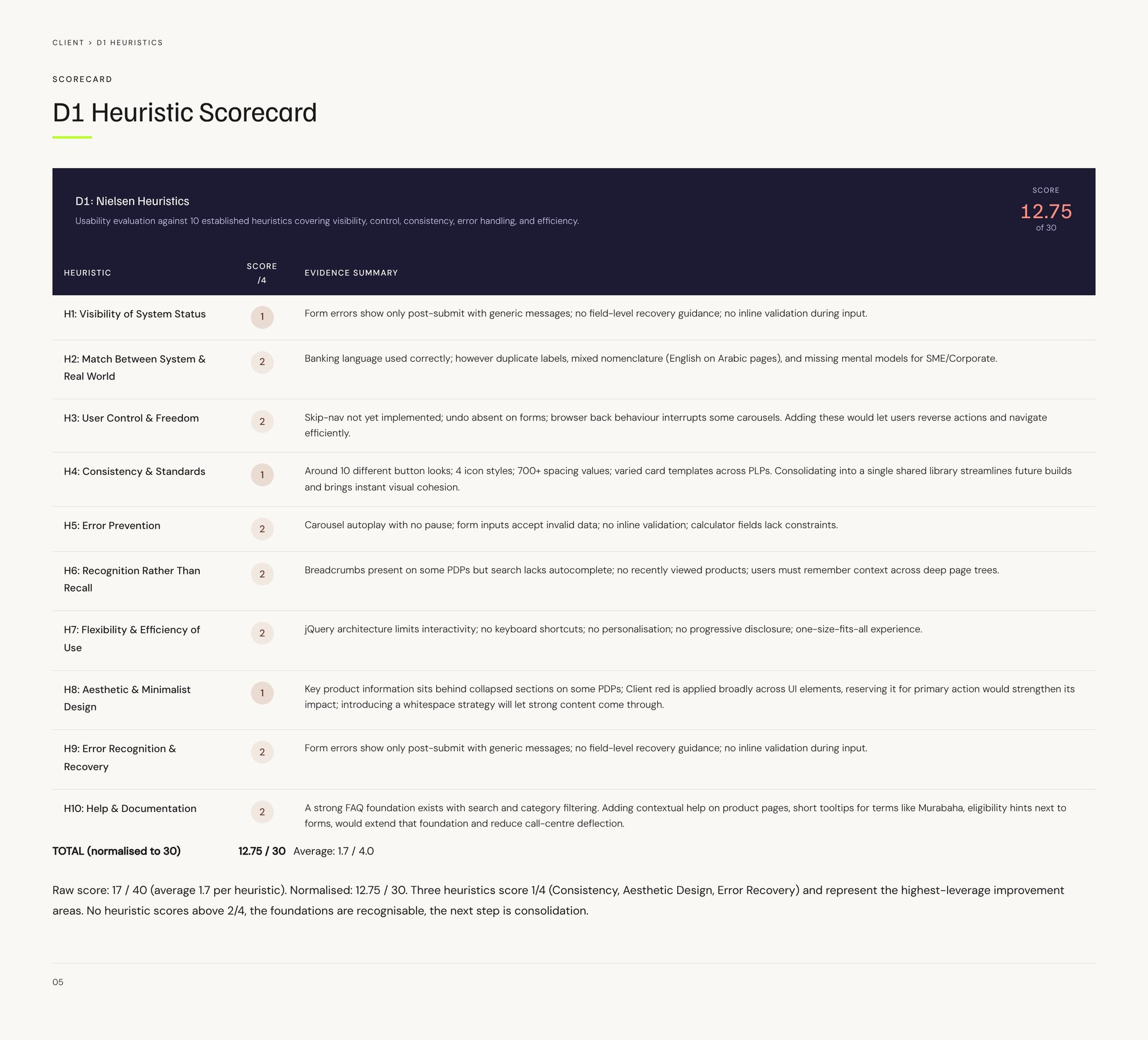
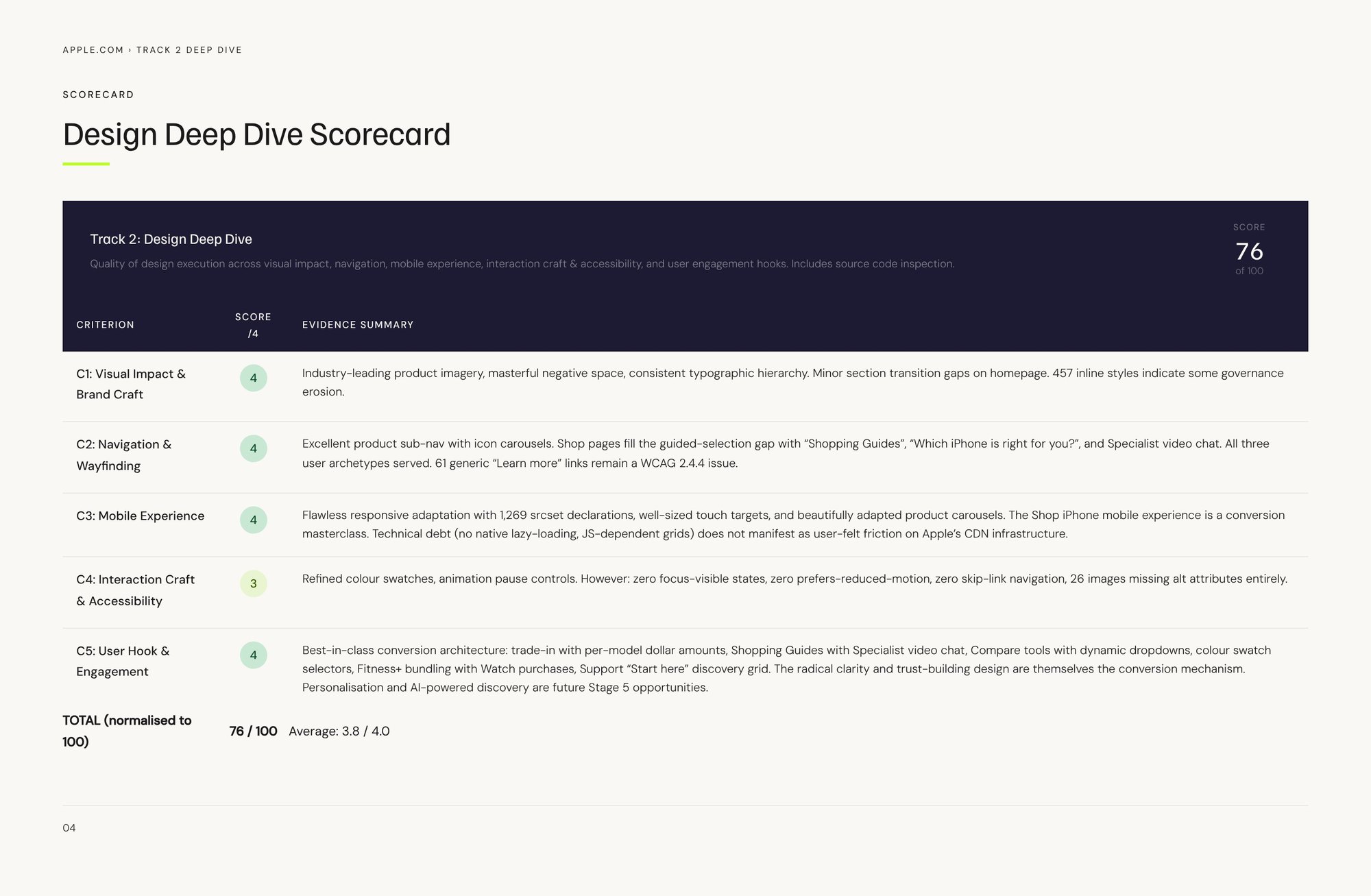
A heuristics scorecard with evidence summaries

Step 04

Score the four dimensions

Each dimension runs against defined criteria and rolls up to a 100-point score: heuristics, user needs, conversion readiness and design execution.

Every score carries an evidence summary, so a number is never left to speak for itself.

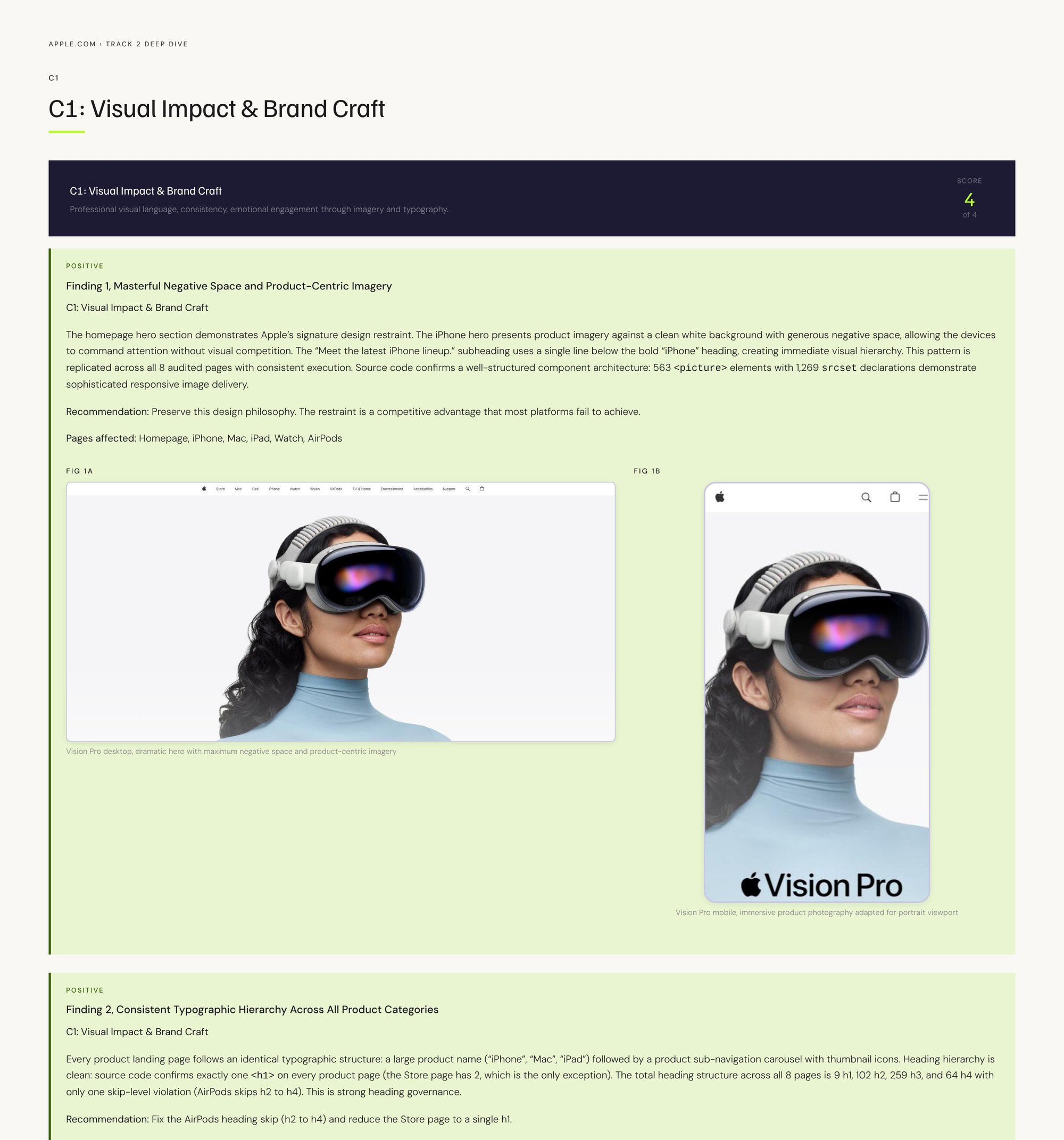
A finding page: severity, recommendation, pages affected and screenshot evidence

Step 05

Render the report

The output is a branded, presentation-ready report: a cover with the headline score, a scorecard, and finding cards that state the issue, the recommendation, the pages affected and the proof.

03 Designing the Judgment

The hard part was not the automation. It was turning instinct into criteria a machine can apply the same way every time, and that a client can check.

Track 1: one score out of 100

D1 30D2 25D3 25D4 20

30points

D1

Nielsen heuristics

Jakob Nielsen's ten heuristics, each scored 0 to 4 against verified evidence and normalised to 30.

25points

D2

User needs

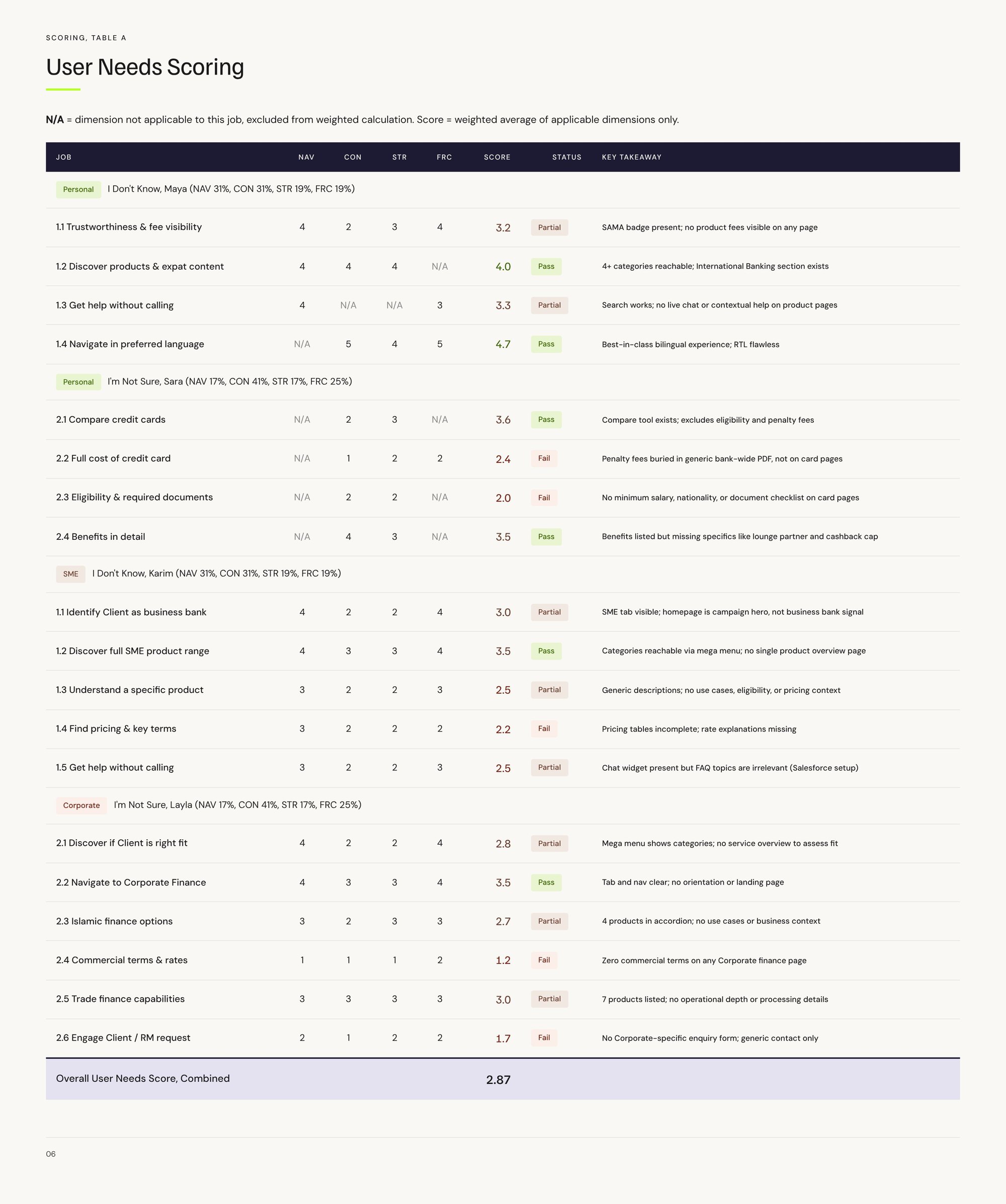
Personas and jobs to be done across need states. Navigation, content, structure and friction are weighted by user type.

25points

D3

Conversion readiness

28 checkpoints across four funnel stages, from homepage to the moment of applying, in six categories from path efficiency to trust.

20points

D4

Design execution

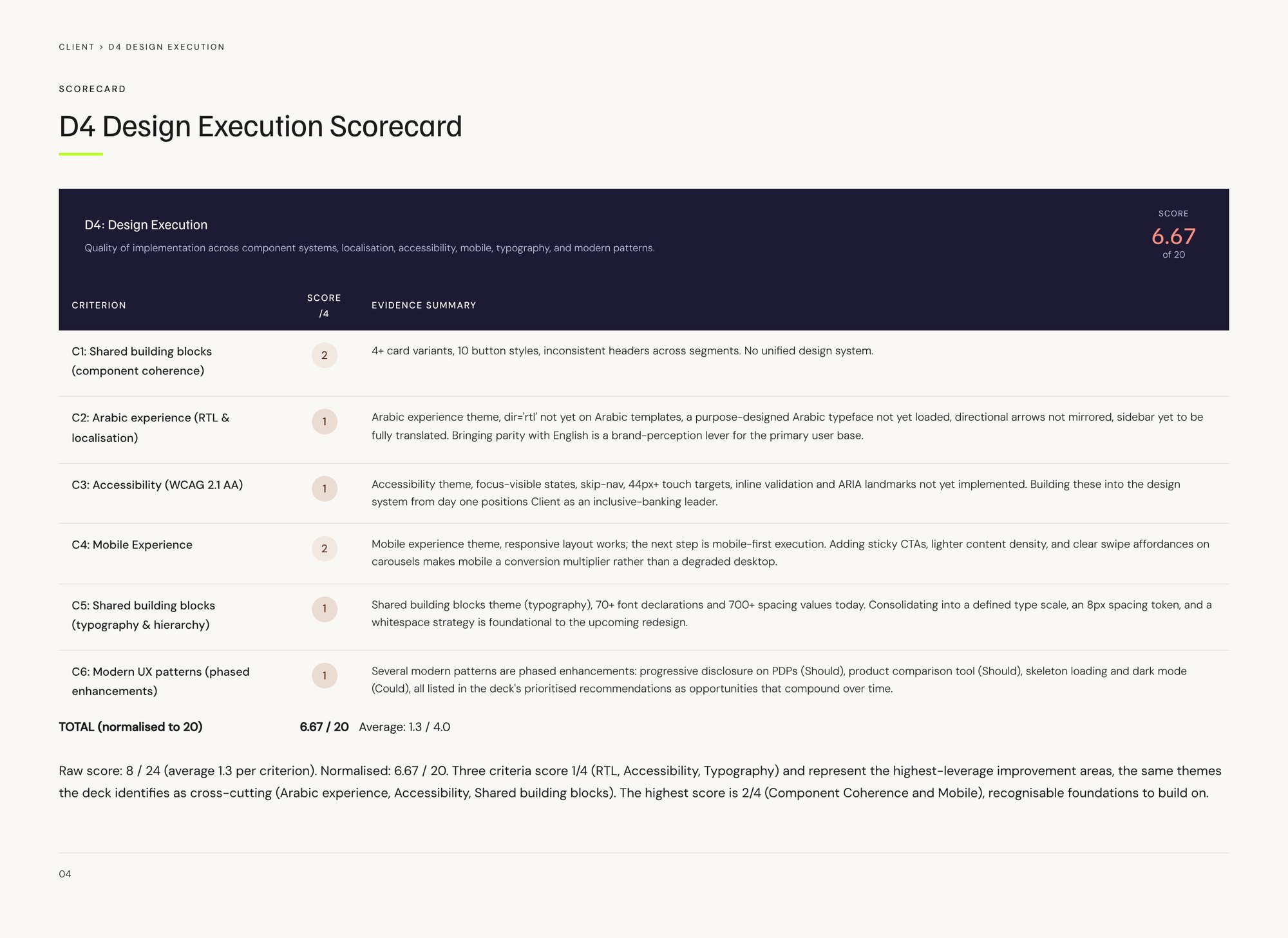
Six criteria: component coherence, Arabic experience, accessibility, mobile, typography and modern patterns.

Track 2

Design deep dive, out of 100

Visual impact & brand craftNavigation & wayfindingMobile experienceInteraction craft & accessibilityUser hook & engagement

Every finding is ranked, so teams know what to fix first.

CriticalModerateMinor

And every finding is verified against live page data. A finding with no proof does not make it into the report.

04 The Output

Scrolling through a Track 2 deep dive report

25 reports for one engagement: a full four-part audit of the client and four competitors, plus five deep dives on platforms from outside banking.

Track 1: inside the client's audit (names and site screenshots hidden)

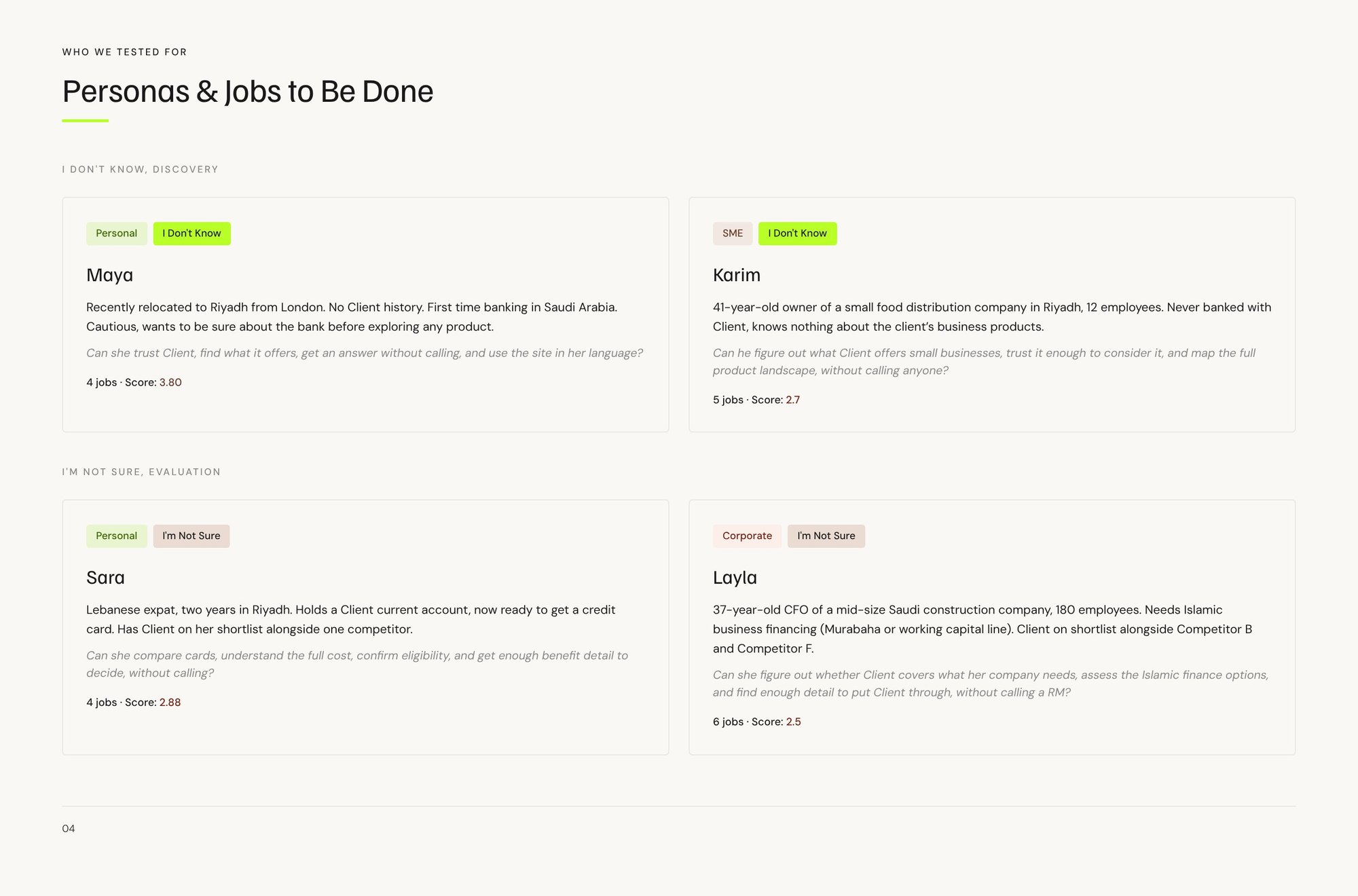
Personas and jobs to be done
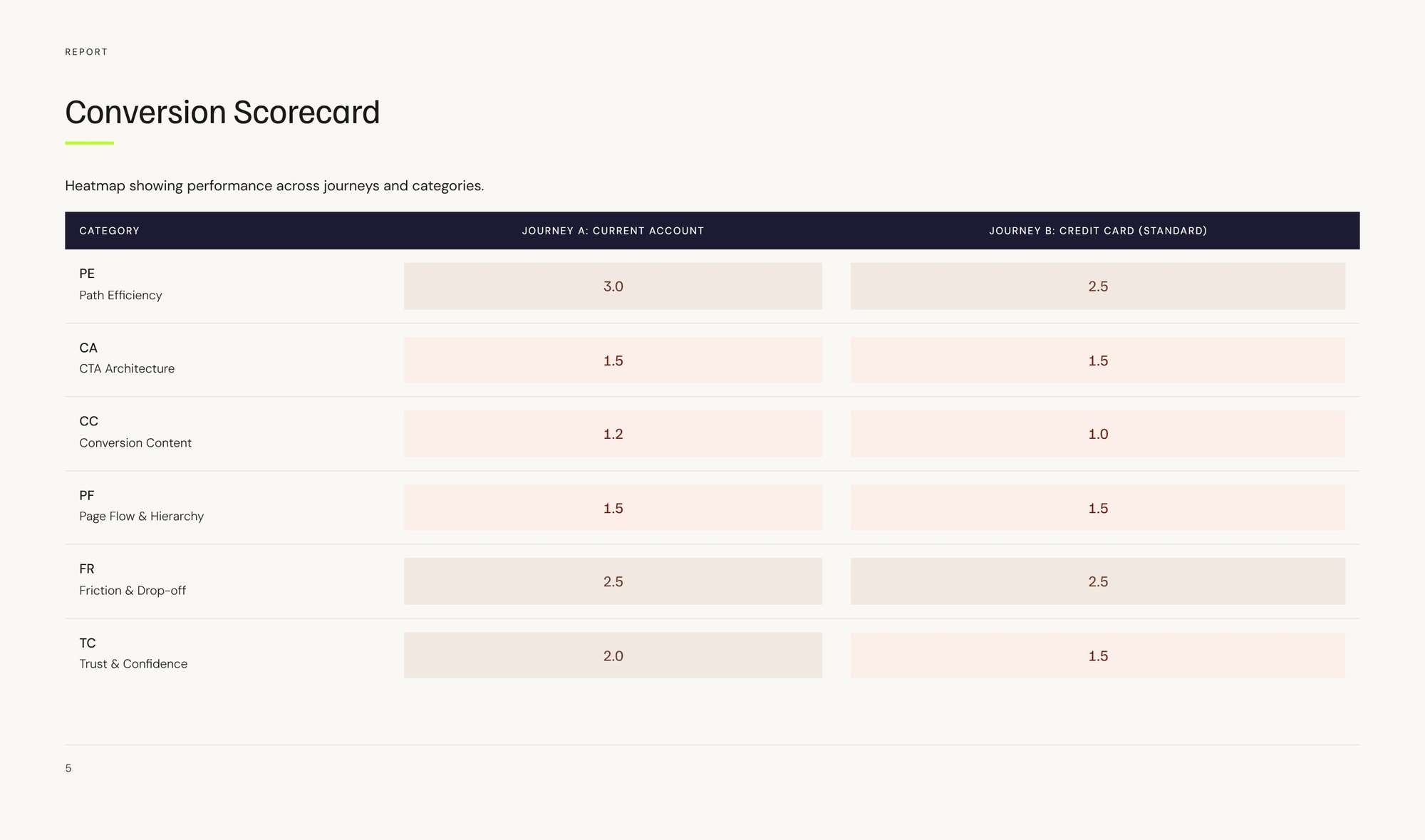
Conversion scorecard heatmap
Design execution scorecard
User needs scoring matrix

Track 2: inside a deep dive

A Track 2 deep dive scorecard
A Track 2 finding with desktop and mobile evidence

05 Design Decisions

A finding card with its evidence

Decision 01

Evidence before opinion

Every finding carries its proof: the screenshot, the pages affected and the data behind it. Close-up crops isolate the exact component in question.

A client team sees the issue for themselves instead of taking it on trust.

master-skill
├─ report stylesheet       brand tokens, finding cards, score tables
├─ benchmarking framework  Track 1 or Track 2, page scope, equivalency
├─ audit foundation        brief, objectives, need states, capture protocol
├─ D1 heuristics
├─ D2 user needs
├─ D3 conversion
├─ D4 design execution
├─ screenshot capture      Zyte API
└─ benchmark orchestrator  combines the four into one report

Decision 02

One master skill

Every capability lives in a single master skill: the framework, the four dimensions, the capture protocol and the report design.

Every audit runs on the same rules, so a competitor scored this week is comparable with one scored last month.

D1
D2
D3
D4

Four conversations, one reportReport ready

Decision 03

Four audits at once

Each dimension runs in its own Claude conversation, in parallel. A full audit becomes four focused runs instead of one long one, which is a large part of how a week becomes hours.

06 Reflection

01

AI is most useful when it scales judgment, not just output. The system does not replace the evaluation. It makes sure the same standard is applied to every page, every platform and every audit.

02

The judgment is the work. The AI scales it.

03

Built recently, in active use.

Next Case Study

Qiddiya Booking Journey

A modular booking system for Qiddiya's two flagship parks, handling multiple ticket types, add-ons and group bookings across web and mobile.

View Case Study
Qiddiya Booking Journey
Let's talk

Open to senior product design roles across global teams.